Garment printing and embroidery equipment · SALATI image archive
The artwork comes first
One design. Many ways to make it.
Start with the effect: a soft print, a sharp raised logo, textured stitching or a light-catching detail. Then match the process to the fabric, artwork, placement and quantity.
SALATI helps turn those choices into a sampling brief for custom hoodies, graphic T-shirts, matching sets and private-label clothing. This guide covers the main industry methods and specialist options; process availability and compatibility are confirmed for each project.
A screen controls where ink meets the fabric. The ink system, color separations and curing process determine coverage, softness and the finished surface. For custom T-shirts and hoodies, start with the actual fabric color and artwork size.
Plastisol screen printing
Ink forms an opaque layer on the fabric surface. A familiar choice for solid logos and bold multicolor graphics.
Consider for
Cotton jerseys, fleece and tested blends; chest logos, back prints and repeat orders.
What to check on the sample
Review ink thickness, coverage on dark cloth, stretch and wash behavior. Polyester may need a dye-blocking system.
Water-based screen printing
Water-based ink systems range from soft, fabric-led prints to opaque high-solids finishes. The recipe matters as much as the name.
Consider for
Soft-feel T-shirt graphics and larger motifs where the garment’s handfeel is a priority.
What to check on the sample
Assess opacity on the chosen color, drying and curing, and the feel after washing. Water-based alone is not a certification.
Discharge printing
A discharge system removes compatible fabric dye in the printed area; pigment can introduce a replacement color.
Consider for
A soft, vintage graphic on suitable dyed cotton, after a fabric test.
What to check on the sample
Not every dye discharges evenly. Check the actual dye lot, residual color, fine detail and the final washed sample.
Halftone & simulated-process printing
Dots and separated color layers reproduce shading, illustrations and photographic effects through screens.
Consider for
Detailed artwork intended for a repeat production run; tonal artwork and vintage-style graphics.
What to check on the sample
Confirm separation count, dot definition, underbase, registration and appearance at the intended print size.
Panel & all-over screen printing
Artwork is printed across fabric or cut panels before sewing. Flatbed and rotary systems suit different repeat patterns and production scales.
Consider for
Repeating motifs, coordinated sets, large sleeve artwork and graphics that extend beyond a standard garment platen.
What to check on the sample
Plan the repeat, panel orientation, seam allowance and seam matching. “All-over” describes coverage, not one specific printing method.
02 / Digital & transfer
Fine detail. Different routes.
Direct printing and transfers can reproduce full-color artwork, but they put the graphic onto the garment in different ways. Compare color, surface feel and compatibility before choosing a process for private-label apparel.
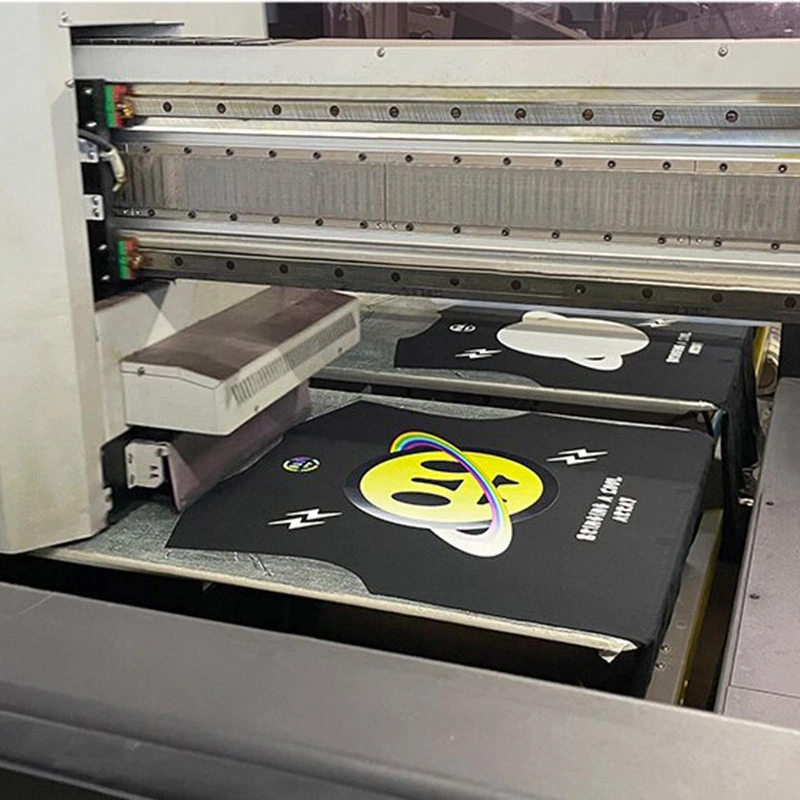
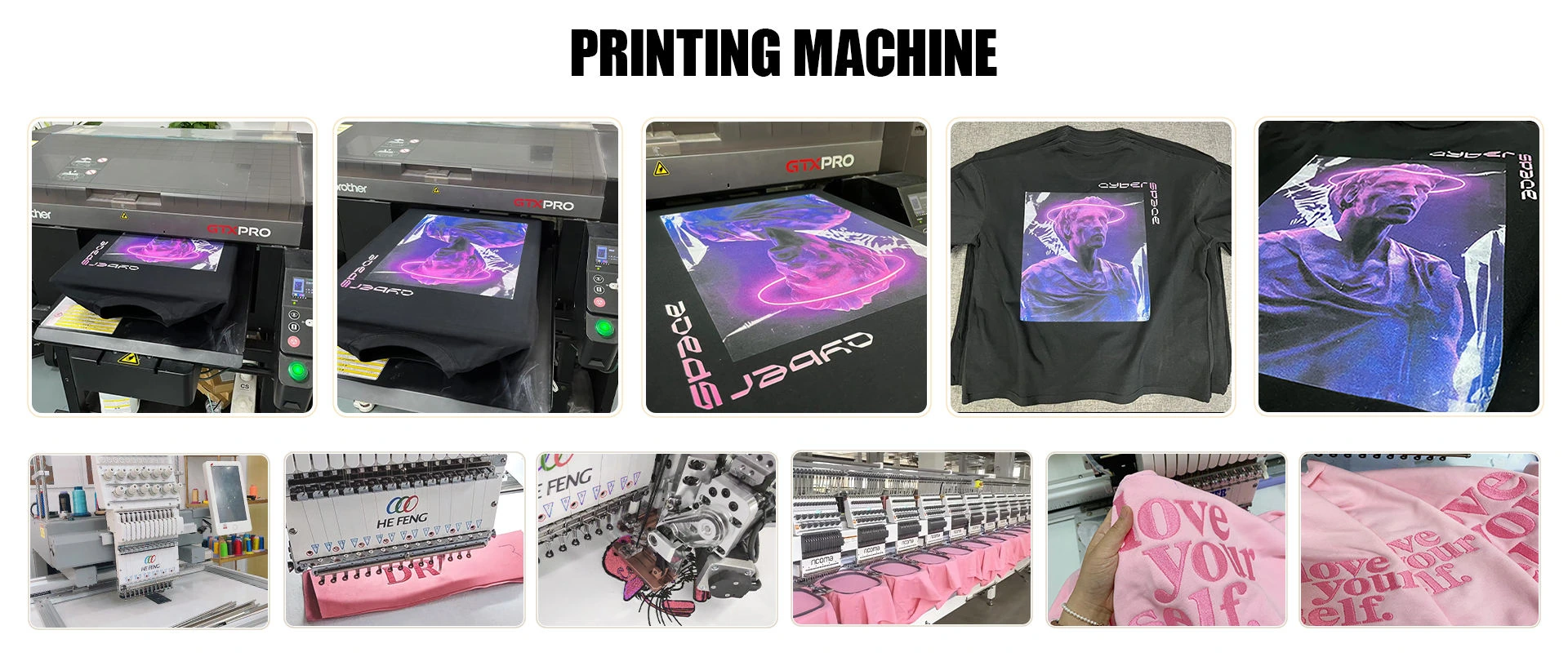
DTG in practiceProcess photographs from the SALATI archive
Garment on the platen
The black T-shirt lies flat on a Brother GTX PRO garment printer, with the artwork positioned on the chest.
Color and image detail
The same purple illustration is visible on the printer. A full-size sample reveals gradients and edge quality on the actual cloth.
The printed garment
Off the platen, the complete T-shirt shows the scale and position of the artwork. Final approval also includes handfeel and care testing.
DTG · direct-to-garment
An inkjet printer applies textile ink directly to a garment. Detailed illustrations and gradients are common applications.
Consider for
Cotton-rich T-shirts and sweatshirts; polyester requires a compatible printer, ink and pretreatment system.
What to check on the sample
Review pretreatment, white underbase on dark fabric, curing, surface fibers and the washed print. Test the exact blank.
DTF · direct-to-film
The graphic is printed onto film, combined with adhesive powder, cured and heat-pressed onto the garment.
Consider for
Full-color logos on many compatible cotton, polyester and blended fabrics, including smaller placement areas.
What to check on the sample
Check adhesion, edge definition, stretch and dye migration. Large solid graphics can feel more covered than an open design.
Dye sublimation
Heat transfers dye into suitable polyester fibers. The design has no separate surface film.
Consider for
White or light polyester sportswear, printed panels and full-coverage patterns.
What to check on the sample
Standard sublimation has no white ink and is not a direct solution for dark cotton. Review polyester content, ghosting and panel alignment.
HTV · cut heat-transfer vinyl
A colored film is cut to shape, weeded and heat-applied. Matte, metallic, reflective, flock and dimensional films create different finishes.
Consider for
Names, numbers, clean lettering and small batches of simple logos.
What to check on the sample
Select a film for the fabric’s stretch and heat tolerance. Test fine cuts, layered areas, edge adhesion and care requirements.
Screen-printed transfers
Screen-printed artwork is prepared on a carrier and heat-applied later, separating print preparation from garment application.
Consider for
Repeated logos, planned releases and graphics applied across several compatible garment styles.
What to check on the sample
Agree the ink and adhesive system, press settings, peel method and fabric suitability with the transfer supplier.
Direct-to-fabric digital printing
A digital textile printer decorates fabric before cutting and sewing. Pigment, reactive, acid and disperse ink routes serve different fibers.
Consider for
Detailed yardage prints, repeating patterns and cut-and-sew collections.
What to check on the sample
Match ink chemistry to the fiber. Confirm fixation or washing requirements, colorfastness, repeat size and the finished fabric handfeel.
Hybrid screen + digital
A screen-printed base or special effect is combined with a digital image in the same graphic.
Consider for
Detailed illustrations that also need a solid base, raised accent or another screen-printed element.
What to check on the sample
Review registration between processes, curing compatibility and the exact order of operations on a complete sample.
03 / Raised & special effects
Give the graphic a surface.
Texture and light can change a simple logo completely. Send SALATI a physical reference when height, softness, shine or reflectivity is central to the design; those qualities are difficult to judge from a flat mockup.
Puff printing
A heat-reactive puff ink expands during curing to create rounded, raised lettering or graphic areas.
Consider for
Bold hoodie logos and simple shapes with enough space between elements.
What to check on the sample
Fine lines and small gaps can close as the print expands. Approve height, outline shape and softness after curing and washing.
High-density printing
A controlled ink build creates a raised surface with more defined edges than a typical puff print.
Consider for
Structured lettering, geometric badges and layered streetwear graphics.
What to check on the sample
Review edge sharpness, print height, flexibility and adhesion. A taller deposit changes the garment’s feel and folding behavior.
Silicone & gel-effect printing
Specialist systems create smooth, flexible raised graphics; clear gel effects can add gloss over selected areas.
Consider for
Dimensional logos and performance-inspired details on compatible fabrics.
What to check on the sample
Specify matte or gloss, height and stretch. Confirm dye blocking where needed and test bonding to the selected cloth.
Flock printing & flock transfers
Short fibers bond to an adhesive design or arrive as a heat-applied flock layer, giving the motif a velvet-like surface.
Consider for
Soft-touch lettering, retro graphics and tactile logo accents.
What to check on the sample
Compare pile density, shedding, edge definition and washing. Flock is a fiber surface, while suede-effect ink imitates a soft texture.
Foil & holographic transfers
A metallic or holographic film bonds to selected areas, creating a light-catching graphic.
Consider for
Shiny logos, limited-edition accents and contrast against matte fabric.
What to check on the sample
Approve reflectivity in ordinary light, adhesion and the aged appearance after care testing. Avoid assuming a mirror finish stays unchanged after wear.
Metallic, glitter & pearlescent inks
Special pigments or particles add sparkle, shimmer or a metallic appearance without using a continuous foil sheet.
Consider for
Statement graphics, outlined logos and highlights inside a larger print.
What to check on the sample
Check particle scale, handfeel, print detail and color in several lighting conditions.
Reflective printing
Reflective ink or film returns light toward its source, creating a different effect under direct illumination.
Consider for
Fashion logos and reflective accents on compatible garments.
What to check on the sample
Compare daylight and illuminated appearance. A decorative reflective print does not by itself establish a safety-apparel rating.
Glow, UV & color-change effects
Specialist inks can glow after light exposure, react under blacklight, or change appearance in response to light or temperature.
Consider for
Novelty graphics and selective accents where the changing effect is part of the design.
What to check on the sample
Confirm the precise mechanism, activation conditions, effect duration and wash stability. These finishes are not interchangeable.
Worn-looking graphics and tactile accents on sweatshirts and T-shirts.
What to check on the sample
Distinguish an intended crackle effect from failed adhesion. Approve the texture and its development after washing.
04 / Embroidery
Draw with thread.
Embroidery converts artwork into a stitch program. Thread, backing, stitch direction and the fabric’s stability influence the result. Salati Apparel sample review should include the reverse side and how the garment feels against the body.
Embroidery in practiceProcess photographs from the SALATI archive
The stitch in progress
An embroidery head works over a pink garment. Hooping and stabilization support the fabric as the motif is stitched.
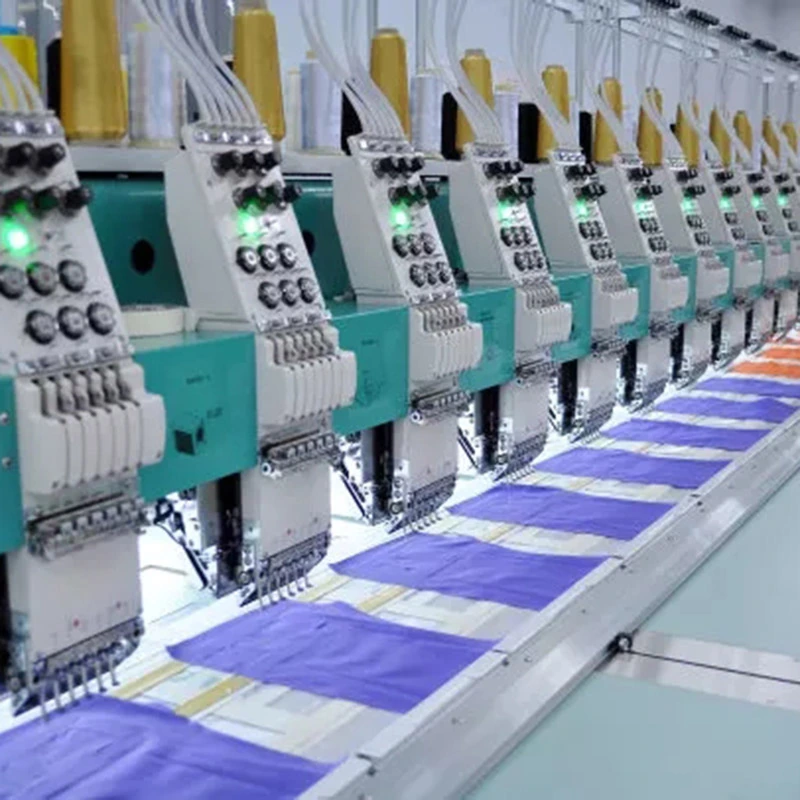
Repeating the placement
Multiple embroidery heads repeat a program across hooped garments. Placement and thread consistency remain part of sample approval.
The finished lettering
The finished pink-on-pink lettering shows thread coverage, edge definition and its relationship to the base fabric.
Flat embroidery
Satin stitches, fill stitches and running stitches build a graphic directly onto the base fabric.
Consider for
Chest logos, crests, small artwork and branded details on stable jersey, fleece and woven garments.
What to check on the sample
Review letter size, stitch density, puckering, thread color and backing. Enlarge or simplify details that cannot stitch cleanly.
Outline & chain-stitch embroidery
A traced outline leaves the interior open; chain stitches create a linked, drawn quality.
Consider for
Script, line art and lighter-looking motifs with visible base fabric.
What to check on the sample
Check line continuity, thread tension and whether the chosen stitch holds the intended curve and lettering.
3D puff embroidery
Specially digitized stitching covers a foam support to lift parts of the design above the surface.
Consider for
Bold letters and shapes on stable caps, jackets and selected heavier garment areas.
What to check on the sample
Check foam coverage, corners, cut edges and fabric support. It uses thread and foam, unlike heat-expanded puff ink.
Chenille / towel embroidery
Loop and chain stitch techniques produce a soft, textured pile, often used in varsity lettering.
Consider for
Large letters, badges and retro graphics on heavier sweatshirts and outerwear.
What to check on the sample
Compare pile height, edge finish, backing bulk and laundering. Small internal spaces need sufficient clearance.
Cording, taping & ribbon embroidery
Cord, tape or ribbon is guided onto the surface and secured with stitches, adding a distinct raised line.
Consider for
Script, ornamental outlines and textured motifs on stable panels.
What to check on the sample
Check corner turning, material joints, snagging and how securely the cord or tape is attached.
Fringe & tassel embroidery
Controlled long stitches or thread ends create a loose fringe as part of a stitched graphic.
Consider for
Expressive lettering and tactile details on fashion sweatshirts or denim.
What to check on the sample
Approve fringe length and anchoring, then assess tangling, shedding and the effect after care testing.
05 / Appliqué & embellishment
Build the motif in layers.
Fabric, patches, stones and hardware bring materials into the artwork itself. Placement and attachment must suit the garment’s weight, movement and intended care. Combine processes only after reviewing the complete assembly.
Appliqué & tackle twill
Cut fabric shapes are stitched to the garment. Twill, felt, jersey or contrasting cloth can supply the color and texture.
Consider for
Varsity letters, oversized logos and layered motifs that would be dense if fully embroidered.
What to check on the sample
Specify fabric, layer order and edge stitching. Check shrinkage between layers and the weight of the finished design.
Reverse & raw-edge appliqué
Reverse appliqué exposes a lower layer through a cut upper layer; raw-edge appliqué allows an intentionally frayed border.
Consider for
Vintage-style graphics, contrasting fabric reveals and distressed lettering.
What to check on the sample
Define the cut line, securing stitches and acceptable fraying. Review the effect after washing, not just before finishing.
Embroidered & woven patches
A separate badge is embroidered or woven, then sewn or heat-applied to the garment using a specified backing.
Consider for
Crests, repeat brand badges and placements where a separate patch is preferable to direct embroidery.
What to check on the sample
Confirm small-letter legibility, edge treatment, backing and attachment. Woven patches and embroidered patches have different textures.
Rhinestones & crystal transfers
Stones arranged into artwork are heat-bonded, sewn or mechanically set, depending on the component.
Consider for
Sparkling text and selective highlights on hoodies, T-shirts and denim.
What to check on the sample
Agree stone size, color and spacing. Test attachment, heat sensitivity and the garment’s care method on the selected fabric.
Sequins & beadwork
Sequins or beads are stitched onto the garment by suitable equipment or hand application.
Consider for
Decorative fills, outlined graphics and details where sparkle and movement matter.
What to check on the sample
Review attachment, snagging, reverse-side comfort and weight. Use an appropriate care plan for the complete embellished garment.
Studs, rivets & metal motifs
Metal components are arranged into patterns and attached using the component’s specified setting method.
Consider for
Denim, outerwear and reinforced graphic areas.
What to check on the sample
Check placement, backing protection, sharp edges, attachment strength and the effect on wear comfort.
Molded silicone, TPU & leather-look badges
A separately formed badge adds a dimensional logo, then attaches by sewing, bonding or another compatible process.
Consider for
Outerwear branding, sports-inspired logos and tactile accents.
What to check on the sample
Approve material, thickness, mold detail and attachment. A molded badge is a different construction from silicone printed directly onto fabric.
06 / Other pattern methods
Pattern beyond ink and thread.
Some motifs are formed in the surface or built into the fabric. These methods need to be planned earlier because the base material and garment construction are part of the effect.
Embossing & debossing
A shaped tool creates raised or recessed relief in suitable material, sometimes with a supporting layer.
Consider for
Tonal logos and minimal, dimensional branding.
What to check on the sample
Trial the material and tooling together. Check relief retention, surface marking and appearance after washing and recovery.
Laser engraving & decorative cutting
A controlled laser changes a surface or cuts a motif. It can create tonal denim graphics or accurately shaped appliqué pieces.
Consider for
Compatible denim, felt and other verified laser-processable materials.
What to check on the sample
Confirm material composition and processing suitability. Check contrast, edge condition and retained fabric strength after washing.
Jacquard & intarsia motifs
The motif is knitted or woven into the textile using yarn placement, rather than printed onto a finished surface.
Consider for
Custom knitwear, repeating fabric patterns and color-blocked sweater artwork.
What to check on the sample
Review gauge, yarn count, color changes, floats or backing, and the detail achievable at the intended scale.
Tie-dye, resist & placement dyeing
Resisting or selectively applying color produces patterned areas in the cloth. Hand-dyed effects naturally vary.
Consider for
Organic color patterns, coordinated dyed sets and one-of-a-kind-looking surfaces.
What to check on the sample
Agree a visual range, not pixel-identical repeats. Review colorfastness, placement variation and interaction with later print or embroidery.
Airbrush & hand-painted artwork
Color is sprayed or painted onto selected areas, producing soft transitions or a deliberately hand-worked graphic.
Consider for
Custom art effects, shaded motifs and limited fashion pieces.
What to check on the sample
Approve a representative sample and an acceptable variation range. Specify textile-compatible color, fixation and care.
Burnout / devoré
A specialist process selectively removes one fiber component from a suitable blended fabric to create a translucent pattern.
Consider for
Compatible mixed-fiber fabrics developed specifically for the effect.
What to check on the sample
Confirm fiber composition and specialist processing availability. Review strength, sheerness, handle and finishing before committing to the design.
Choose by the result
What should the artwork feel like?
Use these starting points to narrow the discussion. A strike-off, embroidery sew-out or complete decorated sample turns a visual idea into something that can be compared and approved.
Compare decoration methods by artwork and sample decisions
The design goal
Methods to compare
The deciding details
Photographs & smooth gradients
DTG, DTF or separated screen printing
Base fabric, print feel, image resolution and order quantity
Soft, vintage-looking artwork
Water-based or compatible discharge printing
Dye compatibility, washed color and fine detail
A bold, raised logo
Puff, high-density, silicone or 3D embroidery
Rounded ink, sharp ink edges or visible thread texture
Varsity lettering & textured badges
Chenille, appliqué or embroidered patches
Pile, edge finish, backing and garment weight
Names, numbers & simple lettering
Cut HTV, DTF or screen-printed transfers
Fabric stretch, heat sensitivity and cut detail
Full-coverage fabric patterns
Sublimation, direct-to-fabric or panel printing
Fiber composition, repeat, cut layout and seams
Sparkle, shine or light-reactive detail
Rhinestones, sequins, foil or specialty inks
Attachment, lighting effect and care requirements
From reference to sample
Send the artwork. Keep the details together.
A clear brief lets Salati Apparel assess the intended effect before a print method is fixed. Include the garment’s planned wash or dye treatment: finishing can change ink, thread and adhesives.
Original files, a PDF preview, dimensions, color references and front/back placement. Mark sleeve, pocket and seam-crossing details separately.
02
Fabric & intended effect
Composition, weight, garment color and a close-up or physical reference for softness, relief, shine or thread texture.
03
Quantity & sample approval
Style, color and size breakdown; the required sample scope; and agreed checks for appearance, handfeel, attachment and care.
Artwork & decoration FAQ
Before the first sample.
SALATI’s original product and process archive includes printing, embroidery and applied-detail references. This guide also explains established industry options so a buyer can describe the intended result accurately. Dongguan City Salati Apparel Co., Ltd. confirms the available production route, fabric compatibility, sample scope and quotation for each project; a method appearing in this guide is not a claim that every process is operated in-house.
DTG prints directly onto the garment; DTF transfers the printed graphic from a film; screen printing applies ink through prepared stencils. Compare the actual artwork, fabric composition, garment color, surface feel and quantity. SALATI can review a reference and discuss an appropriate sample route. No one method is best for every cotton T-shirt, polyester garment or hoodie.
No. Puff printing raises an ink layer through heat. High-density printing builds a more defined ink relief. 3D puff embroidery uses thread over a foam support. Ask Salati Apparel to compare the intended texture, edge shape and fabric support, and identify the exact method in the approved specification.
Send the original editable artwork where available, a PDF preview, dimensions in millimeters or centimeters, and a front/back placement drawing. Include color references and the intended fabric. For raster artwork, provide the highest-resolution original at the required output size. Outline fonts or supply the font details. Embroidery needs digitizing; an ordinary image file is not yet a stitch program.
The workable detail depends on the method, fabric and final size. Embroidery needs space for stitches; puff expands; cut film needs weedable details; printed gradients need an appropriate digital or halftone workflow. Oversized artwork may need panel decoration before sewing. A full-size strike-off or sew-out is the useful reference for approving these details.
Yes, mixed-media designs are possible, but the sequence and materials need review. Heat from a later transfer, wash chemistry or dense stitching can affect an earlier decoration. SALATI sample development should test the combined design on the intended fabric, including the reverse side, attachment and care behavior.
An enzyme wash, garment dye or distressed finish can change the print, thread, adhesive or embellishment. Agree whether decoration happens before or after finishing and approve the final sequence. SALATI should receive the desired wash reference together with the artwork, so the final sample shows the complete result.
Print size, locations, colors, screens, stitch count, digitizing, molds, trims, application labor and total quantity can all affect cost. The fabric and finishing route also matter. Send SALATI a quantity breakdown by style, color and size to obtain a project-specific quote. This guide does not set a universal minimum quantity or delivery promise.
Technical reading & photograph sources
Process guidance draws on equipment, ink and material manufacturers. Equipment photographs come from SALATI’s original website archive. Process and surface studies illustrate decoration methods. Confirm the production route and material compatibility for each project.